

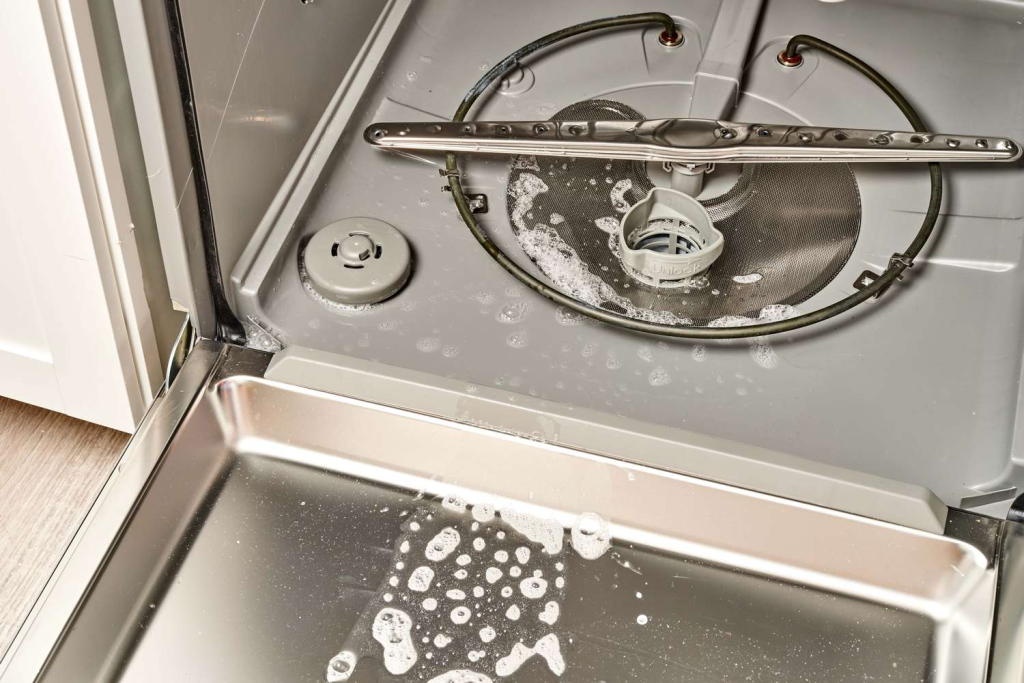
A dishwasher not draining is more than an annoying puddle at the bottom of the machine. It’s usually caused by a blocked filter, a hose problem, or a fault in the original installation. Below are the four common causes in the order worth checking, what you can safely fix yourself, and when to call a licensed plumber.
Common Causes of Standing Water in Your Dishwasher
Standing water in the dishwasher usually comes down to one of four causes. They are listed from the simplest DIY check to the faults that need a plumber or an appliance technician.
Blocked Dishwasher Filter
A blocked filter is a common cause, and the easiest to rule out. Every dishwasher has a filter assembly at the bottom of the tub that catches food scraps, grease, and small debris before they reach the drain pump. Over time, it clogs, and water can’t get through fast enough, or at all.
Switch the dishwasher off at the power point and scoop out any standing water first. Most filters twist or lift out by hand, with no tools required. Rinse it under a hot tap, clear any trapped debris from the filter housing itself, and run a short cycle to check the drain clears. If the dishwasher drains properly afterwards, the filter was your problem.
Kinked or Incorrectly Routed Drain Hose
The drain hose carries wastewater from the dishwasher to your sink’s drain line or garbage disposal. If it’s been pinched, kinked, or looped awkwardly behind the unit, water flow can slow to a trickle or stop altogether.
This sometimes happens simply because the dishwasher has shifted slightly over time. But if the hose was routed poorly during the original installation, with too many tight bends or the wrong length for the cabinetry, it’s an installation fault rather than wear and tear, and pulling the unit out to re-route the hose properly is a job for a plumber.
Drain Hose Positioned Too Low Without a High Loop
Dishwasher drain hoses need a high loop (or an air gap): a section of hose mounted higher than the sink’s drain connection, fitted before they connect to the drain line. Without it, dirty water from the sink or disposal can siphon backwards into the dishwasher instead of draining away, leaving standing water that looks like a drainage fault even though the dishwasher itself is working fine.
A missing or badly positioned high loop is almost always an installation issue, not something that develops on its own. It’s also one of the most common oversights in DIY or budget installs, which is exactly why we build the height and loop check into every dishwasher installation we carry out, right from the outset. Correcting it after the fact means accessing the hose run under the sink and re-securing it at the right height.
Failed Pump or Solenoid
If the filter is clear and the hose is properly routed and looped, the problem may be mechanical: a worn-out drain pump or a faulty drain solenoid that isn’t opening the valve to let water out. You’ll often notice a humming sound with no water movement, or no sound at all.
This is an appliance repair issue rather than a plumbing one, and typically means calling an appliance technician or the manufacturer, since it involves replacing an internal part rather than anything in the water supply or drainage.
What You Can Safely Check Yourself
Before booking a tradesperson, these checks are safe for most homeowners to run through:
- Clean the filter: Remove it (check your manual if you’re not sure how it releases), rinse it thoroughly, and clear any debris from the housing underneath.
- Check the drain hose for obvious kinks: Pull the dishwasher out slightly if you can access it safely, and look for sharp bends or pinch points.
- Run the garbage disposal, if you have one: A dishwasher drain hose often connects through the disposal, and a clogged drain on that side will back up into the dishwasher.
- Check for food build-up around the drain valve or spray arm: This can sometimes mimic a drainage fault.
- Note what you hear: A humming or buzzing sound with no water movement points towards the pump or solenoid, which is useful information for whoever you call next.
If you’ve worked through these and the dishwasher still isn’t draining, the cause is most likely the hose routing, the high loop, or a mechanical fault, none of which are safe or practical DIY fixes.
Signs It’s Time to Call a Plumber
Call a plumber rather than continuing to troubleshoot if you notice any of the following:
- Standing water returns within a cycle or two of cleaning the filter, which points to the hose or high loop rather than debris.
- Water backs up into the dishwasher from the sink or disposal, even when the dishwasher itself isn’t running, a classic sign of a missing or incorrect high loop.
- The dishwasher was recently installed or moved, and drainage problems started straight after, suggesting the hose wasn’t routed or looped correctly during installation.
- You can see the drain hose is kinked, crushed, or positioned below the sink’s drain connection, but can’t safely access or correct it yourself.
- There’s a persistent smell of standing water, or water pooling under the cabinetry near the dishwasher, which can indicate a leak at the hose connection rather than just a drainage delay.
Any of these point to the original plumbing installation rather than the dishwasher itself, and that’s not something to leave. A poorly routed or unlooped drain hose can lead to repeat backups, water damage to cabinetry, or a hygiene issue if it’s left unresolved.
Getting Your Dishwasher Drainage Fixed Properly
Once you’ve worked through the checks above and the water’s still sitting there, there’s no reason to keep living with it. A licensed plumber can re-route a kinked hose, fit a proper high loop or air gap, or confirm the drain connection meets code, fixing the fault at its source instead of a stopgap that fails again in a few months.
For existing drainage issues, contact us, and we’ll have someone out to diagnose and fix it properly, available 24/7, Melbourne-wide.
Recent Comments